Active gaming (Exergaming) continues to grow in popularity and more and more schools are beginning to implement these modern physical activities. It is essential that teachers educate themselves on how to appropriately use active gaming in their physical education classroom to maximize learning. There is finally a hands on, education workshop all about active gaming. The workshop will take place on March 1st, 2012 at the Chicago Bulls Sox training academy in Illinois.
Here is a brief description:
This Professional Development / Exergame Education Workshop shows you the exciting possibilities of how using technology, combined with games and physical activity, can enhance and enrich the lives of generations.
Teachers who attend the pre-conference will hear information from leaders in the field about how exergaming can help educators to be even more effective in reaching our youth. Participants will find this full-day ExerGaming pre-conference fun, educational, and invaluable in helping to promote high-quality physical education and physical activity to maximize the educational experience.
Topics include:
Medical view on how a sedentary lifestyle is impacting our children with life-long disease.
A successful School and Community Model overview, showing results of improved academics, improved disciplinary incidents, and improved health and fitness scores.
Implementing Technology and Exergaming in your facility. Putting knowledge into practice.
How do we prove it is working? Using technology to revolutionize physical education.
Time in vs. Time Out. Help students with ADHD and other behavior issues decrease impulsivity and improve learning. Explains the physiology of the attention system.
Quality teaching in a Physical Education setting, which meets the NASP standards and promotes lifelong fitness.
You can find more information about the workshop including registration at http://www.motionfitness.com/Articles.asp?ID=269
Friday, January 20, 2012
Thursday, January 12, 2012
So You Think You Can Dance?
I often find that dance is one content area that many teachers do not enjoy teaching for a variety of reasons. Dance is an essential part of the physical education curriculum, but what are you doing to make it fun and interesting? Why not consider implementing dance related active games such as Dance Dance Revolution or Just Dance (1, 2, or 3) that is compatible with the Nintendo Wii and Microsoft Kinect. These active games are appropriate tools that can assist physical educators in teaching rhythmic, folk, creative, etc., dance concepts. These games offer various genres of music from reggae to hip hop which provides the teacher with numerous opportunities to create diverse dance lessons for students. Additionally, students are exposed to different forms of music and are able to learn the history as well as different forms of rhythm in the music.
Implementing technology driven games (active games) is a desirable solution for children to be motivated to engage in exercise. These activities are also affordable and user-friendly. Teaching dance in physical education can be enhanced by using what this generation of students finds appealing and fun. So, do you think you can dance? Try it and let the game be the test!
Thursday, January 5, 2012
Active Gaming: Making Exercise a New Year's Resolution?
It's that time of the year - the beginning! Where we sit and think about what our New Year's resolution is going to be. For many, in the past few years a resolution has been to exercise more consistently or to simply begin to exercise. While I certainly appreciate adding more exercise to your daily life, I would also like to suggest we DECREASE sedentary screen time. Sitting in front of computers, televisions, cell phones, iPods, etc., has become a habit - one which is hard to break. The national recommendations suggest recreational screen time (RST) be less then two hours a day. On average RST in society today is over 40 hours a week! If we are going to using screens, at least reduce the sedentary behavior and suggest a more active approach such as active gaming.
Although the benefits of traditional exercise are well known, for some reason as adults we decrease our level of physical activity and then our children do not have role models at home to follow. Physical education teachers need to encourage children to get up and move and provide them with ways to do so at home. Discussing active gaming and implementing it in your curriculum is a great way to show children how exercise can be fun.
Do yourself and your children a favor this year and reduce the amount of sedentary time you spend in front of a screen. Get up and move - if you enjoy video games and technology, active gaming may be one great solution to help you keep your New Year's resolution!
Wednesday, October 19, 2011
Medical Doctors and Active Gaming – A Nice Surprise!
I recently was asked to present a workshop and a short presentation on active gaming and gamification at the 12th Annual Conference on Obesity titled “Practical Approaches and Guidelines to Treatment” in Orlando, FL by the University of South Florida Medical group. I have presented on active gaming at this conference for the past 3 years and have found the interest from the medical doctors that attended to be desirable. This year, I was able to have multiple conversations with the attendees regarding there thoughts about active gaming as a form of physical activity prescription.
To clarify, the conference was a 3 day event. My two presentations were the ONLY presentations that focused on physical activity in obesity treatment and prevention. Although I found this disappointing, especially as I listened to intense research presentations based on how surgery and pills were a safe way to control and/or prevent obesity, I took advantage of the opportunity and began each presentation with this comment:
“To date, there is not one pill I know of on the market that can provide the benefits that physical activity provides. We know how physical activity positively affects the mind and body in a variety of ways. I am not suggesting pills and surgery do not work, I am merely saying that prescribing physical activity should be something you consider with every case unless there are physical limitations with the patient.” Physical activity will never be a bandaid – are pills and surgery?”
To my happiness as I looked in the audience the majority of heads were shaking as if they were agreeing. BINGO! Now it was time to have these doctors really think I was strange by telling them they should prescribe screens as a source of physical activity! Needless to say, the understanding of how technology has caused an increase in sedentary behavior among adults and children was not difficult for them to comprehend. Allowing the attendees to actually play on Dance Dance Revolution, Gamercize Steppers, Microsoft Kinect, and the Xavix virtual boxing game was a great way for them to laugh at themselves, enjoy the activity, and learn how active gaming can be a great solution to motivating their patients to be more active. Additionally, they learned the cost of these particular games as well a many other active games is feasible!
One Doctor pulled me to the side after the first presentation and shared that after he heard the presentation on active gaming last year, he had completely removed all seats from his waiting room and added Dance Dance Revolution, the Game Bikes, and a Nintendo Wii system. He discussed how his patients would come early and stay later just to be able to play the games. This Doctor also believed that these activities created more interaction between the families when they were at his practice. What a wonderful story to share! Of course, I used this example in my second presentation to bring awareness to the attendees on how active gaming could serve as a fun, motivating way to be encourage more physical activity as well as how, as doctors, they could use this approach as a role model for their patients’ home environment.
There mindset of "just go outside and play" is still desired. Quite frankly, I still desire it as well; however, the fact that this is simply not happening as generations change is a reality and was understood. We need to strategies to help these adults and children be more active. Why not prescribe active gaming? It is appropriate, and not simply a bandaid!
Thursday, September 29, 2011
Get Connected: Insight on Microsoft Kinect
Thank you to Natalie Hunter from Seattle who works with onlineschools.org for being our guest blogger and providing us with insight about the popular Microsoft Kinect active video game. Thank you Natalie!
In the past, playing video games was often a sedentary activity which involved little use of one’s body. Other than pressing keys or moving a controller, video games would rarely require one to exert any degree of physical effort. As we move into the modern age, society is choosing to spend ore time staring at screens at home and at work as well as moving toward to taking classes from onlineschools.org instead of being physically active. However, thanks to gaming developments like the Kinect, at least playing in our free time doesn't also have to be that way. The Kinect requires no controller other than the player's body, and precisely tracks body movements as one plays. Today, P.E. teachers can incorporate video games into their classes through the use of the many games for the Kinect designed for exercise.
One Kinect game that is excellent for P.E. teachers who wish to use video games for exercise is Your Shape Fitness Evolved. The game begins by determining one’s goals and selecting a corresponding virtual personal trainer who can help reach these goals. Your Shape Fitness Evolved includes yoga, martial arts classes, and many other various games that can effectively burn calories while providing fun.
Another fun, highly active Kinect game is called Dance Central. Dance Central is a sort of evolved version of the ever-popular Dance Dance Revolution that incorporates the movements of the entire body, coordinating dance moves to classic songs like Jungle Boogie or modern pop music like Lady Gaga. Although this game does not provide the in-depth, detailed workout programs that are found in Your Shape Fitness Evolved, many students may find the dancing aspect of the game to be more appealing than yoga or martial arts classes.
These are just a few examples of active games that can be played on the Kinect, but there are dozens more. With the ability to keep track of the whole body, there are so many possibilities to keep kids active with their entire bodies and with their minds as well. With so many options available, meeting one’s daily exercise requirements can be as fun and simple as loading up a
video game.
In the past, playing video games was often a sedentary activity which involved little use of one’s body. Other than pressing keys or moving a controller, video games would rarely require one to exert any degree of physical effort. As we move into the modern age, society is choosing to spend ore time staring at screens at home and at work as well as moving toward to taking classes from onlineschools.org instead of being physically active. However, thanks to gaming developments like the Kinect, at least playing in our free time doesn't also have to be that way. The Kinect requires no controller other than the player's body, and precisely tracks body movements as one plays. Today, P.E. teachers can incorporate video games into their classes through the use of the many games for the Kinect designed for exercise.
One Kinect game that is excellent for P.E. teachers who wish to use video games for exercise is Your Shape Fitness Evolved. The game begins by determining one’s goals and selecting a corresponding virtual personal trainer who can help reach these goals. Your Shape Fitness Evolved includes yoga, martial arts classes, and many other various games that can effectively burn calories while providing fun.
Another fun, highly active Kinect game is called Dance Central. Dance Central is a sort of evolved version of the ever-popular Dance Dance Revolution that incorporates the movements of the entire body, coordinating dance moves to classic songs like Jungle Boogie or modern pop music like Lady Gaga. Although this game does not provide the in-depth, detailed workout programs that are found in Your Shape Fitness Evolved, many students may find the dancing aspect of the game to be more appealing than yoga or martial arts classes.
These are just a few examples of active games that can be played on the Kinect, but there are dozens more. With the ability to keep track of the whole body, there are so many possibilities to keep kids active with their entire bodies and with their minds as well. With so many options available, meeting one’s daily exercise requirements can be as fun and simple as loading up a
video game.
Labels:
active gaming,
kinect,
physical education,
video games
Sunday, August 21, 2011
Technology: Part of the Wellness Revolution in Schools?
The article below has been circulating and came across my computer multiple times via google alerts and social networking posts. I find it interesting that someone with traditional beliefs speaks openly about the importance of using technology, including active gaming in phyiscal education classes. See the article below or here:
Champaign, IL (PRWEB) August 18, 2011
The 10 Ways to Start a Wellness Revolution in American Schools
According to the late Phil Lawler, fitness-based physical education focusing on health and wellness has been proven to make students healthier, smarter, and better behaved. Unfortunately, the man deemed the "Father of the New PE" by Dr. Kenneth Cooper thought the majority of American educators, school board members, and parents were still unaware of the research regarding the positive impact of exercise on the brain. In an age where physical education programs continue to be cut or deemphasized, Lawler believed that awareness and understanding levels must increase dramatically, as detailed in the forthcoming book "Game Changer: Phil Lawler's Crusade to Help Children by Improving Physical Education" (Human Kinetics, September 2011).
“The research on exercise’s positive impact not only on health—which is big enough in this era of childhood obesity—but on learning readiness, as well as behavior and mood, means PE needs to be the foundation of the whole education process,” said Lawler, who passed away in 2010. "Game Changer," written by the nonprofit organization PE4life, pays tribute to his wellness-based approach to PE that energized a revolution in the world of education. To advance this movement faster, the book pinpoints 10 key factors that represent Lawler’s approach to transforming education through fitness-based PE and movement-based learning:
1. Create awareness in your community and beyond. “It’s simply a shame that more people—educators, parents, the media—don’t know about the powerful research supporting exercise as a learning-readiness tool,” said Lawler. He believed a large-scale campaign of education and communication was needed.
2. Target school boards, administrators, and parents. Principals, superintendents, school board members, and parents all have to buy in to the exercise-for-learning message. According to Lawler, “They need to fully understand and accept that kids that are more fit not only are healthier but also more ready to learn. They also behave better in the classroom.”
3. Make technology a cornerstone of physical education. Lawler thought that exergaming was the future of PE and, to a larger degree, the future of education in general. Exergaming combines the latest technological advances with state-of-the-art exercise equipment to provide students with a practical and enjoyable way to increase their fitness levels and cognitive functioning.
4. Continually strive to be innovative. School administrators need to keep finding new ways to keep children engaged and active. “Bottom line, we need to constantly be rewriting the book on PE,” Lawler stressed. “It needs to be Real World PE 101, PE that makes sense to students, parents, and the public for a lifetime.”
5. Incorporate more movement in the classroom. Integrating movement into the education process, throughout the day and in the classroom, is the cornerstone of changing the way education is done. Conducting lessons while standing up or moving around the classroom is a step in the right direction because neuroscience has shown that movement facilitates cognition and that knowledge needs to be translated to the classroom.
6. Make physical education part of the scoreboard. In most situations, PE is not part of a student’s grade point average (GPA). With the new PE, there’s no logical reason for physical education not to be part of students’ GPA. “A student’s PE grade—if the PE program is health and wellness based—needs to be part of the GPA,” Lawler emphasized. “If not, you’re sending the message to students and parents that PE isn’t important.”
7. Constantly emphasize the link between the body and the brain. Enhancing the learning process must always be the major reason that physical education and exercise should be part of every curriculum. Lawler credited the growing mound of research on the positive impact of exercise on the brain for his belief that physical education will ultimately be the hub of the education wheel.
8. Get the community involved. Since this is a challenge in education and funding, more and more people are needed to spread the message about how fit children are smarter, better behaved, and healthier. Corporate America also needs to fully understand what this all means for their own future and the future of this country.
9. Revamp college programs for physical education teachers. In an environment where childhood obesity rates are increasing and overall fitness levels are declining, a health and wellness model must be the focus of PE training programs in order for physical education to meet the needs of 21st-century students.
10. Research to drive the revolution. Without research supporting the new PE philosophy and highlighting the benefits of exercise for academic performance, there will never be enough momentum to result in a paradigm shift in the world of education.
If these 10 factors are undertaken in earnest as Lawler suggested, this revolution can be expedited and begin enhancing the lives of more children. “I would bet that 97 percent of the country is still closer to the old PE than they are the new PE,” he admitted. “That’s completely unacceptable given the powerful research demonstrating the benefits of exercise in a learning environment.”
Read more: http://www.digitaljournal.com/pr/395753#ixzz1VfpX6Ule
Champaign, IL (PRWEB) August 18, 2011
The 10 Ways to Start a Wellness Revolution in American Schools
According to the late Phil Lawler, fitness-based physical education focusing on health and wellness has been proven to make students healthier, smarter, and better behaved. Unfortunately, the man deemed the "Father of the New PE" by Dr. Kenneth Cooper thought the majority of American educators, school board members, and parents were still unaware of the research regarding the positive impact of exercise on the brain. In an age where physical education programs continue to be cut or deemphasized, Lawler believed that awareness and understanding levels must increase dramatically, as detailed in the forthcoming book "Game Changer: Phil Lawler's Crusade to Help Children by Improving Physical Education" (Human Kinetics, September 2011).
“The research on exercise’s positive impact not only on health—which is big enough in this era of childhood obesity—but on learning readiness, as well as behavior and mood, means PE needs to be the foundation of the whole education process,” said Lawler, who passed away in 2010. "Game Changer," written by the nonprofit organization PE4life, pays tribute to his wellness-based approach to PE that energized a revolution in the world of education. To advance this movement faster, the book pinpoints 10 key factors that represent Lawler’s approach to transforming education through fitness-based PE and movement-based learning:
1. Create awareness in your community and beyond. “It’s simply a shame that more people—educators, parents, the media—don’t know about the powerful research supporting exercise as a learning-readiness tool,” said Lawler. He believed a large-scale campaign of education and communication was needed.
2. Target school boards, administrators, and parents. Principals, superintendents, school board members, and parents all have to buy in to the exercise-for-learning message. According to Lawler, “They need to fully understand and accept that kids that are more fit not only are healthier but also more ready to learn. They also behave better in the classroom.”
3. Make technology a cornerstone of physical education. Lawler thought that exergaming was the future of PE and, to a larger degree, the future of education in general. Exergaming combines the latest technological advances with state-of-the-art exercise equipment to provide students with a practical and enjoyable way to increase their fitness levels and cognitive functioning.
4. Continually strive to be innovative. School administrators need to keep finding new ways to keep children engaged and active. “Bottom line, we need to constantly be rewriting the book on PE,” Lawler stressed. “It needs to be Real World PE 101, PE that makes sense to students, parents, and the public for a lifetime.”
5. Incorporate more movement in the classroom. Integrating movement into the education process, throughout the day and in the classroom, is the cornerstone of changing the way education is done. Conducting lessons while standing up or moving around the classroom is a step in the right direction because neuroscience has shown that movement facilitates cognition and that knowledge needs to be translated to the classroom.
6. Make physical education part of the scoreboard. In most situations, PE is not part of a student’s grade point average (GPA). With the new PE, there’s no logical reason for physical education not to be part of students’ GPA. “A student’s PE grade—if the PE program is health and wellness based—needs to be part of the GPA,” Lawler emphasized. “If not, you’re sending the message to students and parents that PE isn’t important.”
7. Constantly emphasize the link between the body and the brain. Enhancing the learning process must always be the major reason that physical education and exercise should be part of every curriculum. Lawler credited the growing mound of research on the positive impact of exercise on the brain for his belief that physical education will ultimately be the hub of the education wheel.
8. Get the community involved. Since this is a challenge in education and funding, more and more people are needed to spread the message about how fit children are smarter, better behaved, and healthier. Corporate America also needs to fully understand what this all means for their own future and the future of this country.
9. Revamp college programs for physical education teachers. In an environment where childhood obesity rates are increasing and overall fitness levels are declining, a health and wellness model must be the focus of PE training programs in order for physical education to meet the needs of 21st-century students.
10. Research to drive the revolution. Without research supporting the new PE philosophy and highlighting the benefits of exercise for academic performance, there will never be enough momentum to result in a paradigm shift in the world of education.
If these 10 factors are undertaken in earnest as Lawler suggested, this revolution can be expedited and begin enhancing the lives of more children. “I would bet that 97 percent of the country is still closer to the old PE than they are the new PE,” he admitted. “That’s completely unacceptable given the powerful research demonstrating the benefits of exercise in a learning environment.”
Read more: http://www.digitaljournal.com/pr/395753#ixzz1VfpX6Ule
Thursday, August 11, 2011
Active Gaming's Global Appeal
We are lucky to have a guest blogger, Richard Coshott of Gamercize, provide us a look at how active gaming is growing in popularity in the UK. What he has written below demonstrates the global attention active gaming is receiving in physical education classes. Thank you for sharing Richard:
When you think about Active Gaming (AG) you may be thinking about images of Wii Bowling in retirement accommodations, or maybe mom’s keeping up with a Jillian Micheal's fitness regime after the kids have left for school. Another perception you may have comes from the “gaming” aspect of AG, which gives the impression that it’s more of a “boy’s” activity. In my experience with my company Gamercize, I’ve found this is far from the case. Active Gaming is much more than this, and has a much wider appeal, global appeal in fact.
My company, Gamercize, works with many different types of active gaming users, including teachers and schools, and providers products and services to help every person be more active by changing sedentary screen time into active screen time.
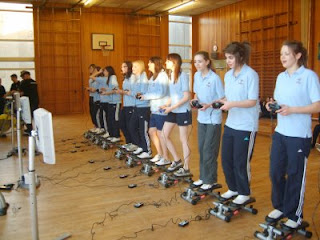
One service we provide is a PE Teacher familiarization and training day, to bring PE and technology together, almost like a hands-on “Show and Tell”. These days are a great way to give us a chance to test out the reactions to different types of games, reaching out to new demographics, and acquire useful feedback from students. One event that appeared to offer different challenges was for a girl’s school. We took along a good selection of games, finding the Xbox 360 offered more variety than the PlayStation 3, that has predominately shooting or racing games. The fun part about the equipment we used was any game would work, the active part of the active gaming being to keep stepping to play.
The XBox 360 video game console supports 4 players, although most readily available and popular games available for them support two players per console. There are options for up to 16 players “linked” and countless social interactions available with online play. The cost per station is far more attractive for multiple players per console and the offline play mode makes it much easier for the teacher to be in control of the session without outside influence.
In the UK the adherence for girls in PE is generally lower than for boys, especially at the age range we had at this school, the teens. Some problems have been recognised and addressed, for example not mandating gym skirts and allowing sweat pants or shorts not appropriate for PE wear, but this group remains the most difficult to keep engaged in class. It’s difficult for teachers to keep to curriculum and progress the children if they only sporadically attend class; I was given the job of working out how to engage them more.
The easiest games to engage boys with are sports games, would the same be true for girls? Sports worked well, but it was clear the girls wanted more variety, so to engage the whole class we had to do a lot more. After changing games on the consoles a couple of times we settled into three different genres on all three consoles. Sports was still popular, fantasy racing won out over pure racing simulation and the last genre turned out best; fantasy adventure. This kept the whole class active and happy, and pleasantly surprised as they were expecting traditional gym work for the lesson, not active gaming!
What surprised me was about half the 16 year old’s in class had arrived not intending to take part in the expected gym class, with parental notes and the old “forgotten kit” excuses. I did wonder how many would have skipped PE had they known Gamercize would be there? From the feedback we had, the girls who were not planning to engage in the class appeared more keen on the active gaming class, with many asking if the equipment would be available next week.
One group that knew active gaming was coming to school was the teachers. After running the classes it is normal to use the equipment as an “ice-breaker” with the teachers and to wind down before reflecting on the lessons learned from the day’s classes. It was long past time to pack up and get on the road, but the competitive nature of PE teachers was overriding the message from the school clock. Of course do-overs were the order of the day as we battled it out with Super Monkey Ball Grand Prix.
The only other time you will see engagement over such wide demographics is with traditional sedentary video games. Although technology is not normally associated with the Physical Education department, the active version of video games looks very promising for attendance rates. The teachers certainly saw the appeal, which is always more conducive in a hands-on environment when the reactions of students can be seen first hand and the equipment tried out by all ages.
Subscribe to:
Posts (Atom)