Showing posts with label video games. Show all posts

Friday, January 18, 2013


A former student of mine, Zach Foder, has made a significant difference in student learning in his physical education program. Please read the following from Zach and I strongly encourage you to view his website and click on the active gaming link below!

This is what Zach wrote:


Simply put, I love my job. 

Every day I am able to show others what my students have accomplished and strive to plan more interactive and engaging lesson plans. Often times, more than I expected, simply telling others about what we have done at the Immokalee Community School does not provide justice for the dedication, hard work and commitment of my students to be healthy and physically active for a lifetime!

As a graduate of the University of South Florida (12') and a first year student at Boise State University (M.Educational Technology) I wanted to enter my profession with passion, excitement and experiences that many students and parents had never even dreamed of.  The opportunity to develop an Active Gaming Lab (AGL) was one of those such opportunities!  Video games and exercise?!  I was motivated to create developmentally appropriate experiences during physical education that could answer that such question...video games and active technologies CAN be used to teach students about the concepts state and national standards adhere to.

I was fortunate enough to transform my space into an active gaming, health and fitness educational learning center!  Students are given the opportunity to explore the various fitness concepts like muscular strength, muscular endurance, flexibility and cardiovascular endurance by actively participating in games like Just Dance, Wii Jog, Gamercize, Dance Dance Revolution and Wii Cyberbike!  The level of student engagement and active participation has increased dramatically and the students are excited, motivated and eager to be physically active!

The AGL has provided my physical education program with a safe learning environment that fosters critical thinking, exploration of health and life science concepts, physical fitness concepts, S.M.A.R.T goal setting and an unmatched level of fun and excitement!

The ability to use the AGL as a supplementary tool during physical education has worked to increase student motivation in the classroom, provided opportunities for students to use various forms of appropriate technology like APPS and the iPad while simultaneously developing the passion and excitement for physical activity that the National Association for Sport and Physical Education (NAPSE) strives for!

Working in accordance with my budget, I was dedicated to work, save and implement many active gaming technologies of my own...whatever is necessary to keep the AGL running.  With the ability to combine personal and work equipment, the opportunities are endless for the AGL!  In addition to applying for grants, many of the events held at the Immokalee Community School like the Annual Immokalee Fit Kids Marathon, etc are used to fundraise and maintain the AGL.  Sharing my excitement about the new active gaming educational center at the Immokalee Community School is a top priority in order to continue to grow, develop and explore the new and cutting edge tools that can be used to educate my students.  

Students are excited, more now than ever, to be a part of the Immokalee Community School physical education program and participate in the active gaming educational center!  It is my hope to continually fundraise and do everything necessary in order to provide the students with the tools they need to be physically educated individuals.  

If you would like to see the Immokalee Community School Active Gaming Lab in use please do not hesitate to visit my website @ http://www.coachzpe.com and click on the Active Gaming Link!

I am confident that we as physical educators, can and will, keep active gaming alive and thriving in our schools! In addition to regular physical education, active gaming has enriched my program and ensured that my students are prepared and willing to be physically active for a lifetime!  

Zach Fodor
Physical Eduator
Immokalee Community School
Immokalee, FL


Thank you Zach for sharing your experience with active gaming with us!

Thursday, April 19, 2012

Active Gaming to Compliment Fitness Testing?


For years we have been trying to find a more desirable way to test fitness levels in children. When I was teaching in elementary school I can still remember the sighs' coming from the students when it was time to "run the mile". There is really not much teachers can do about this...cardiovascular efficiency must be tested, right? Finally, there is a study that has been conducted that has set the stage for further research and exploration of how teachers may finally have a way to make testing more fun and motivating. You can find the entire blog on the Exergame Fitness website here.

The objective of the study is as follows:

"Objective: The purpose of this study was to examine whether a correlation existed between the scores of the Jackie Chan Action Run active video game, the one-mile run/walk and Progressive Aerobic Cardiovascular Endurance Run (PACER) aerobic fitness tests of the FITNESSGRAM® in order to provide a potential alternative testing method for days that are not environmentally desirable for outdoor testing."

I think this study has many implications for physical education teachers. Not only may this active game be an appropriate method of testing students in the future; but, it may also serve as a great way to help students prepare for testing and improve fitness levels in and out of school. The Jackie Chan Action Run video game is feasible in cost and could serve as a great Christmas or birthday present and most teachers would have the funding to include this game in their curriculum!

Friday, April 6, 2012

National Public Health Week

I read a great blog today about National Public Health week (April 2-8). The article mentions active gaming/exergaming in what I believe is a positive and accurate manner. Here is part of the blog that discusses exergaming:

"Furthermore, the recent surge in "exergaming," a term used to describe video games that also serve as a type of exercise, is providing an innovative approach to promoting physical activity. Video games for interactive boxing and dancing get people up and moving, sometimes burning energy at levels comparable to moderate forms of exercise. Some schools have set up exergaming stations, and these interactive exercise sessions have been very popular among students, especially encouraging less athletic, often obese or overweight students to become more active. While these approaches do not solve the problem of physical inactivity for all Americans, they provide creative alternatives to traditional fitness activities and offer an exciting way to reduce sedentary time as well as promote physical activity."

You can read the entire blog here. It is wonderful that exergaming continues to grow in popularity and the physical activity benefits provided by participating in some of these activities are becoming more apparent.

Friday, February 3, 2012

Wii in Adapted PE?? Wii in Adapted PE!!


I am thankful to adapted physical education teacher Amy Wellik from Mounds View Pubic Schools for being a guest blogger this week! Amy brings to our attention the important subject regarding how active gaming can be beneficial when teaching adapted physical education. As she makes clear, children with disabilities not only enjoy and desire active gaming, but are capable of finding great success at the activies. Here is what Amy has shared:

Teaching students with disabilities in an Adapted Physical Education (Adapted PE) setting has many similarities to teaching Physical Education to students in the general setting. Students with disabilities are more like their non-disabled peers than not. They like pizza, Disney channel, pop music and technology. They recognize and have the ability to use iPads, iPhones, Nintendo DS and Nintendo Wii.
And just like their peers, keeping motivated, interested and MOVING is a challenge.
Adapted PE teachers and PE teachers need to be creative and innovative about using technology in their gyms.
When I first introduced Nintendo Wii into my Adapted PE classes, it was an “experiment”.
I was not sure how my students would respond and how successful they would be. I quickly discovered that the majority of my students were familiar with the Nintendo Wii and they were thrilled to use it in school.
Two years later, I have successfully incorporated a variety of games, activities and exercises into my Adapted PE curriculum.
If the goal is participation, movement and improved fitness levels, Nintendo Wii is an excellent solution.
Nintendo Wii Activities I have used in Adapted PE:
• Students with Autism Spectrum Disorder (ASD):Wii Fit (Basic run) Wii Sports (Bowling, Boxing training) Just Dance, Just Dance Kids
• Students with Physical Disabilities: Wii Fit, Wii Sports, Just Dance
• Students with Visual Impairments: Wii Fit (Basic run) Wii Sports (Bowling, Boxing training)
• Students with Cognitive Disabilities: Just Dance, Just Dance Kids, Wii Sports , Wii Fit
Technology is in our schools, classrooms and in our gyms. This generation of students understands how to interact with technology and they are motivated by technology. Incorporating technology into any Physical Education class will enhance learning, increase fitness levels and improve participation.

Thank you Amy!

Wednesday, October 19, 2011

Medical Doctors and Active Gaming – A Nice Surprise!


I recently was asked to present a workshop and a short presentation on active gaming and gamification at the 12th Annual Conference on Obesity titled “Practical Approaches and Guidelines to Treatment” in Orlando, FL by the University of South Florida Medical group. I have presented on active gaming at this conference for the past 3 years and have found the interest from the medical doctors that attended to be desirable. This year, I was able to have multiple conversations with the attendees regarding there thoughts about active gaming as a form of physical activity prescription.

To clarify, the conference was a 3 day event. My two presentations were the ONLY presentations that focused on physical activity in obesity treatment and prevention. Although I found this disappointing, especially as I listened to intense research presentations based on how surgery and pills were a safe way to control and/or prevent obesity, I took advantage of the opportunity and began each presentation with this comment:

“To date, there is not one pill I know of on the market that can provide the benefits that physical activity provides. We know how physical activity positively affects the mind and body in a variety of ways. I am not suggesting pills and surgery do not work, I am merely saying that prescribing physical activity should be something you consider with every case unless there are physical limitations with the patient.” Physical activity will never be a bandaid – are pills and surgery?”

To my happiness as I looked in the audience the majority of heads were shaking as if they were agreeing. BINGO! Now it was time to have these doctors really think I was strange by telling them they should prescribe screens as a source of physical activity! Needless to say, the understanding of how technology has caused an increase in sedentary behavior among adults and children was not difficult for them to comprehend. Allowing the attendees to actually play on Dance Dance Revolution, Gamercize Steppers, Microsoft Kinect, and the Xavix virtual boxing game was a great way for them to laugh at themselves, enjoy the activity, and learn how active gaming can be a great solution to motivating their patients to be more active. Additionally, they learned the cost of these particular games as well a many other active games is feasible!

One Doctor pulled me to the side after the first presentation and shared that after he heard the presentation on active gaming last year, he had completely removed all seats from his waiting room and added Dance Dance Revolution, the Game Bikes, and a Nintendo Wii system. He discussed how his patients would come early and stay later just to be able to play the games. This Doctor also believed that these activities created more interaction between the families when they were at his practice. What a wonderful story to share! Of course, I used this example in my second presentation to bring awareness to the attendees on how active gaming could serve as a fun, motivating way to be encourage more physical activity as well as how, as doctors, they could use this approach as a role model for their patients’ home environment.

There mindset of "just go outside and play" is still desired. Quite frankly, I still desire it as well; however, the fact that this is simply not happening as generations change is a reality and was understood. We need to strategies to help these adults and children be more active. Why not prescribe active gaming? It is appropriate, and not simply a bandaid!

Thursday, September 29, 2011

Get Connected: Insight on Microsoft Kinect

Thank you to Natalie Hunter from Seattle who works with onlineschools.org for being our guest blogger and providing us with insight about the popular Microsoft Kinect active video game. Thank you Natalie!

In the past, playing video games was often a sedentary activity which involved little use of one’s body. Other than pressing keys or moving a controller, video games would rarely require one to exert any degree of physical effort. As we move into the modern age, society is choosing to spend ore time staring at screens at home and at work as well as moving toward to taking classes from onlineschools.org instead of being physically active. However, thanks to gaming developments like the Kinect, at least playing in our free time doesn't also have to be that way. The Kinect requires no controller other than the player's body, and precisely tracks body movements as one plays. Today, P.E. teachers can incorporate video games into their classes through the use of the many games for the Kinect designed for exercise.

One Kinect game that is excellent for P.E. teachers who wish to use video games for exercise is Your Shape Fitness Evolved. The game begins by determining one’s goals and selecting a corresponding virtual personal trainer who can help reach these goals. Your Shape Fitness Evolved includes yoga, martial arts classes, and many other various games that can effectively burn calories while providing fun.

Another fun, highly active Kinect game is called Dance Central. Dance Central is a sort of evolved version of the ever-popular Dance Dance Revolution that incorporates the movements of the entire body, coordinating dance moves to classic songs like Jungle Boogie or modern pop music like Lady Gaga. Although this game does not provide the in-depth, detailed workout programs that are found in Your Shape Fitness Evolved, many students may find the dancing aspect of the game to be more appealing than yoga or martial arts classes.

These are just a few examples of active games that can be played on the Kinect, but there are dozens more. With the ability to keep track of the whole body, there are so many possibilities to keep kids active with their entire bodies and with their minds as well. With so many options available, meeting one’s daily exercise requirements can be as fun and simple as loading up a
video game.

Thursday, August 11, 2011

Active Gaming's Global Appeal


We are lucky to have a guest blogger, Richard Coshott of Gamercize, provide us a look at how active gaming is growing in popularity in the UK. What he has written below demonstrates the global attention active gaming is receiving in physical education classes. Thank you for sharing Richard:


When you think about Active Gaming (AG) you may be thinking about images of Wii Bowling in retirement accommodations, or maybe mom’s keeping up with a Jillian Micheal's fitness regime after the kids have left for school. Another perception you may have comes from the “gaming” aspect of AG, which gives the impression that it’s more of a “boy’s” activity. In my experience with my company Gamercize, I’ve found this is far from the case. Active Gaming is much more than this, and has a much wider appeal, global appeal in fact.

My company, Gamercize, works with many different types of active gaming users, including teachers and schools, and providers products and services to help every person be more active by changing sedentary screen time into active screen time.

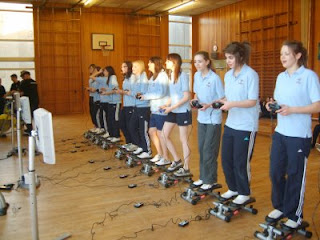
One service we provide is a PE Teacher familiarization and training day, to bring PE and technology together, almost like a hands-on “Show and Tell”. These days are a great way to give us a chance to test out the reactions to different types of games, reaching out to new demographics, and acquire useful feedback from students. One event that appeared to offer different challenges was for a girl’s school. We took along a good selection of games, finding the Xbox 360 offered more variety than the PlayStation 3, that has predominately shooting or racing games. The fun part about the equipment we used was any game would work, the active part of the active gaming being to keep stepping to play.

The XBox 360 video game console supports 4 players, although most readily available and popular games available for them support two players per console. There are options for up to 16 players “linked” and countless social interactions available with online play. The cost per station is far more attractive for multiple players per console and the offline play mode makes it much easier for the teacher to be in control of the session without outside influence.

In the UK the adherence for girls in PE is generally lower than for boys, especially at the age range we had at this school, the teens. Some problems have been recognised and addressed, for example not mandating gym skirts and allowing sweat pants or shorts not appropriate for PE wear, but this group remains the most difficult to keep engaged in class. It’s difficult for teachers to keep to curriculum and progress the children if they only sporadically attend class; I was given the job of working out how to engage them more.

The easiest games to engage boys with are sports games, would the same be true for girls? Sports worked well, but it was clear the girls wanted more variety, so to engage the whole class we had to do a lot more. After changing games on the consoles a couple of times we settled into three different genres on all three consoles. Sports was still popular, fantasy racing won out over pure racing simulation and the last genre turned out best; fantasy adventure. This kept the whole class active and happy, and pleasantly surprised as they were expecting traditional gym work for the lesson, not active gaming!

What surprised me was about half the 16 year old’s in class had arrived not intending to take part in the expected gym class, with parental notes and the old “forgotten kit” excuses. I did wonder how many would have skipped PE had they known Gamercize would be there? From the feedback we had, the girls who were not planning to engage in the class appeared more keen on the active gaming class, with many asking if the equipment would be available next week.

One group that knew active gaming was coming to school was the teachers. After running the classes it is normal to use the equipment as an “ice-breaker” with the teachers and to wind down before reflecting on the lessons learned from the day’s classes. It was long past time to pack up and get on the road, but the competitive nature of PE teachers was overriding the message from the school clock. Of course do-overs were the order of the day as we battled it out with Super Monkey Ball Grand Prix.

The only other time you will see engagement over such wide demographics is with traditional sedentary video games. Although technology is not normally associated with the Physical Education department, the active version of video games looks very promising for attendance rates. The teachers certainly saw the appeal, which is always more conducive in a hands-on environment when the reactions of students can be seen first hand and the equipment tried out by all ages.


Sunday, August 7, 2011

Active Gaming in PE - See it for yourself!

Researchers at the University of South Florida have been conducting studies to better learn how active gaming fits in the physical education classroom as well as the academic classroom. This is an educational video of active gaming and how it relates to the academic and physical education classroom - http://www.youtube.com/watch?v=wBv1LBpHGIM

This video is fun and easy to follow to understand how active gaming can affect a quality physical education curriculum. Notice the students in the video smiling while exercising as well as the teacher's positive comments about how active gaming has motivated her students to enjoy being active.

Tuesday, March 15, 2011

Active Gaming: Research and Results!


My intention of this quick blog is not to bore you with a ton of recent research articles about active gaming. However, it is my intention to make you aware of the fact that active gaming has been in the media lately on multiple occasions - for the good! Below I have included links to several media stories that provide support for using active gaming as a form of beneficial physical activity. Let me say this - Active Gaming CAN be an appropriate tool to use in your physical education classroom. When implemented according to the national standards as well as following developmentally appropriate practices, these activities may certainly benefit your students:

http://consumerist.com/2011/03/video-games-are-good-for-kids.html

http://www.familypracticenews.com/news/more-top-news/single-view/exergames-players-expend-energy-at-real-life-play-levels/5a239edddd.html

http://children.webmd.com/news/20110307/active-video-games-help-kids-burn-calories

Addtionally, check out The Exergame Network blog where you can find more information about research research as well as additional resources that provide evidence supporting active gaming in the physical education classroom.

Monday, January 24, 2011

Exergaming Award Winners: TEN Network Reveals It ALL


In a previous blog, I discussed a survey released by the TEN Network awarding the top Exergames in various categories. Below are the results from the Survey as stated in the TEN Network blog post that you can find here:


The full results of The Exergame Network Awards 2010 are as follows;


- Best Children's Exergame - WINNER: Dance Dance Revolution Disney Grooves by Konami

- Best Physical Education Exergame - WINNER: Gamercize Pro-Sport for Wii

- Best Seniors Exergame - WINNER: Nintendo Wii Sports Bowling

- Best Accessibility Exergame - WINNER: Nintendo Wii Sports

- Best Home Dance Exergame - WINNER: Konami DDR

- Best Commercial Grade Dance Exergame - WINNER: Positive Gaming iDANCE2

- Best Exergame Fitness Avatar - WINNER: Wii Yoga

- Best Rehabilitation Exergame - WINNER: Nintendo Wii Fit and Wii Fit Plus

- Best Group Exergame - WINNER: Positive Gaming iDANCE2

- Best Gateway Exergame - WINNER: Nintendo Wii Sports

- Best Competition Exergame - WINNER: Gamercize Pro-Sport for Xbox 360

- Best Brain Exergame - WINNER: NeuroActive BrainBike

- Best Music in an Exergame - WINNER: Positive Gaming iDANCE2

- Best Commercial Exergame 2010 - WINNER: Positive Gaming iDANCE2

- Best Home Exergame 2010 - WINNER: Microsoft Kinect Sports


”The inaugural TEN Awards is a significant initiative to raise public awareness of the commercial grade Exergaming solutions available world wide and to honour the key pioneering manufacturers in this exciting health and fitness genre” says Brett Young, founding member of The Exergame Network and CEO of Exergaming Australia.

”The first ever TEN Awards is a great step in helping both consumers and healthcare professionals know where to start when trying to select (or recommend) an exergame for their particular need. The voting was from a wide array of exergaming enthusiasts from around the globe. I believe this is a great start and hope that this will encourage game developers and exergaming manufacturers to continue to produce great products and raise the field of exergaming” says Dr. Ernie Medina, Jr., DrPH, founding member of The Exergame Network, CEO of MedPlay Technologies, and the “Exergaming Evangelist/Interventionist”.

Thursday, January 13, 2011

I wanted to share this article...a good and easy read about active gaming with the exception of one paragraph that is a little vague:

"During one session run by Miller's research assistants last month, it was clear how four students felt about leaving a well-organized dodgeball game in the regular gym to go play video games in a smaller gym."

I am not sure if dodgeball will ever be a developmenally appropriate activity (I may get a few emails for this) yet the article demonstrates how video games may have a strong effect on children and their desire to be physically active. Another powerful statement in which I have observed and believe:

"If you're not an athlete, you generally are not going to have a good time in PE," said Todd Miller, who teaches exercise science at George Washington University. "But if you do something like Dance Dance Revolution, you can play the most athletic person in the class and still win."

In response to this statement, I have observed many unskilled, overweight children experience success with active gaming. There may be something to this generation - an open mind may serve well.

Sunday, December 26, 2010

Christmas Time: Affordable Active Games!


I previously wrote a blog about physical education teachers promoting active games over sedentary video game play as potential Christmas presents for children. I would like to simply extend that post and suggest just a few specific active games that are affordable, feasible, and easy to use:

Dance Dance Revolution - Multiple webistes provide multiple a variety of games and pads to fit your financial desire.
Nintento Wii Games - Sports, Resorts, Fit, etc...
Microsoft Kinect
Gamercize Steppers - compatible with multiple video game consoles (PS3, XBox 360, Nintendo Wii)
Virtual Bikes - A variety of video game bikes that offer residential pricing.
Xavix games - boxing, jackie chan, tennis

As quality physical education teachers - we need to make sure we are promoting healthy alternatives to the sedentary lifestyles in which many of our children are engaging in everyday.Suggest active games - not the traditional sedentary game! Inform parents, administration, and other teachers. It is a simply solution to replace sedentary screen time with more active play.

Sunday, December 19, 2010

Active Gaming in Yahoo!News


Recently, Yahoo!News produced a nice article and video regarding active gaming and physical education. I really enjoyed this article and video because active gaming and traditional physical activity were not compared as one being "good" or "bad". Often, the media produces articles leading the reader to be persuaded that either active gaming is the "new pe" or that the "old pe" (more traditional play) is still the best strategy for physical education teachers to employ and video games are the enemy to this generation. What is hard for many to understand is that a key to appropriately implementing active gaming in physical education is to use these modern activities as a tool to assist students in accomplishing learning objectives. Active gaming is aligned with what our children desire and enjoy; however, these technologies should never be seen as a replacement for fitness and skill development.

Dominique Dawes, a former U.S Olympic gymnast, joined Yahoo!News and myself at one of the USF active gaming research labs located in a local elementary school. Dominique had a blast learning about active gaming and playing with the students. Once she was able to experience the games, hear and see the students' excitement, and witness her own heart rate being quickly elevated while playing, Dominique began to understand why active gaming can certainly be an appropriate tool for physical education teachers to use in their programs. Read the full article here.

Monday, December 6, 2010

Integrating Active Gaming in the Classroom


Integration of academic material into the physical education classroom OR physical education content into the academic classroom is a well known strategy that quality physical educations teachers are not only aware of but do try to incorporate into the school curriculum. Considering 65% of children do NOT recieve any physical activity outside of school hours, it only seems appropriate that the physical education teachers get on board and begin advocating for more physical activity time during the school day. A major issue is that many administrators and classroom teachers believe more seat time is better and more effective. Unfortunately, recent research suggests this is simply not the case. Active Kids are Healthier Kids...Bottom Line!

Children that are moving more frequently during the day are proven to spend more time on task and consequently learn more efficiently. Is there something I am missing or should we not be getting our children up and moving throughout the day to improve learning....The No Child Left Behind Act is going to be left behind if we continue forcing children to be sedentary throughout the school day!

At the University of South Florida, researchers have started investigating the use of active games in the academic classroom. Active games are used as stations in the classroom before and after school, during bell work, after assignments are complete, and to "control" behavior issues. The teachers and students suggest the games are fun, effective in controlling off task behavior,and...guess what? Children are actually LEARNING!

Incorporating active video game play in the academic classroom is a great way for physical education teachers to integrate physical activity throughout the school day to accomodate for a lack of physical education time. There are many economical and appropriate active games (Gamercize, Dance Dance Revolution, Footgaming, etc.) that can easily be used in the computer lab or in the classroom as a station that encourages teachers to let children move while learning! If the children and teachers like it, AND learning occurs - why would we not want to encourage it?

Active Kids are Healthier Kids! Active Gaming is FUN, HEALTHY, and EFFECTIVE!

Monday, November 29, 2010

Healthy Christmas Presents For Children!


That special time is once again approaching! Black Friday has come and gone which means - Christmas time already! Many parents spend money buying children their favorite gifts and toys....guess what is #1 on many children's lists? VIDEO GAMES! Introducing children to the concept of active video games is a healthy alternative to sedentary video game play. As physical educators, it is important that we are able to make children and parents aware of healthy alternatives to sedentary toys and gifts. Physical education teachers may or may not have active video games in their classrooms; however, putting together a newsletter, parent letter, or website blog to educate parents and children about active video games is a great way to advocate for physical activity incorporating games that children desire to play.

Just to name a few economical and fun active games parents could consider: Nintendo Wii, Dance Dance Revolution, Microsoft Kinect, Gamercize, Sony Move, etc. Many of these are compatible with video game consoles (PS2, PS3, Nintendo, XBox, etc) children already have at home. Check out the PE Central Website for examples of active games that are appropriate, feasible active games for use at home in which may serve as excellent christmas gifts.

Monday, November 22, 2010

Executive Fitness Director Supports Active Gaming


Recently, the Executive Fitness Director, Shellie Pfohl, visited the University of South Florida's Active Gaming research labs to learn more about the research being conducted and to deliver a message regarding childhood obesity at the USF Education in Action Luncheon. See my previous blog about this event here. After visiting the labs, Shellie mentioned she believed active gaming was a "trend" that she would like to see increase in numbers in physical education programs and schools. During the presentation at the luncheon she suggested "...active gaming arcades like this are the future for physical education and they are part of a comprehensive physical education (P.E.) program." It was nice to hear Shellie discuss active gaming as a learning tool in physical education, not a replacement for skill and fitness development. See the full article about this visit and the luncheon presentation from the Oracle below and here:

Executive fitness director commends USF health research
By Michael Velez and Crystal Wilson, CORRESPONDENTS


Published: Monday, November 22, 2010

Updated: Monday, November 22, 2010 01:11

Shellie Pfohl, executive director of the President’s Council on Physical Fitness and Sports, visited Belle Witter Elementary to see how its gaming labs work.
At Belle Witter Elementary School in Tampa, students are actually encouraged to play video game during class.

That's because they're part of a new program developed by USF researchers to keep children physically fit — a trend Shellie Pfohl, executive director of the President's Council on Physical Fitness and Sports, said she hopes to see increase.

"I think active gaming arcades like this are the future for physical education and they are part of a comprehensive physical education (P.E.) program," she said during a lecture at the Tampa Fairgrounds.

Students attend the Witter Active Gaming Lab at least twice per week for 30-to 60-minute video game sessions that contribute to their physical education. All of the video games require movement.

In "Xavix Boxing," students strap on gloves that register their boxing movements. For "Gamercize" students stand atop stair-steppers and must remain active for the game to progress(LH).

In fall 2007, the School of Physical Education and Exercise Science received a $526,000 collaborative grant from the Centers for Disease Control and Prevention (CDC). The Active Gaming Research program received about $125,000 of the grant and used it to create the lab along with a donation from Gamercize including four steppers (LH).

"We purchased all of this active gaming equipment with the idea that kids are more motivated and engaged to be physically active when they can also play video games that they're playing at home and the like," said Steve Sanders, director of the School of Physical Education and Exercise Science. "It's a lot different than doing sit-ups and push-ups and running laps around the field, which kids don't like to do."

Pfohl, who was appointed to her position by President Barack Obama earlier this year, toured the school's Active Gaming Lab on Nov. 18. She said the program is valuable because it finds creative ways to target childhood obesity — a problem that "impacts our society in so many ways."

"No matter where you are, no matter what you do in life, childhood obesity should be important to you," she said.

Pfohl said that for the first time in human history, the life expectancy of children may be lower than their parents. The dangers of childhood obesity are obvious, she said, and the effects the epidemic have on society seldom receive enough recognition.

"If we do not look at their health now, my suggestion is that it will bankrupt us in the future," she said. "If this generation of kids is allowed to become more and more obese, when they hit the workforce, many companies will not be able to survive."

Pfohl said increased health care costs and a denigrated work performance directly resulting from obesity may one day sink our economy if nothing is done now to address the problem. The Witter lab gives young people a head start on a positive life, she said.

"To me it's the gateway behavior," she said. "Physical activity is the gateway behavior to so many positive things."

Lisa Hansen, an assistant professor for the School of Physical Education and Exercise Science and co-director of the University's Active Gaming Research Laboratories, said the first lab of this kind, the XRKADE Research Laboratory, was opened on the USF Tampa campus in December 2006.


"We're not suggesting (children) do this instead of traditional (P.E.). We're suggesting they replace the sedentary game time they already do at home and go to something natural," she said. "Moms and dads: go buy active games for Christmas. Don't go buy a ‘Toy Story' (video game) where they sit and play, buy the (version with a)Gamercize stepper, so they can still play ‘Toy Story' but they have to move."

Hansen said that apart from the workout, a major goal of the student's time spent in the lab is to teach them about the equipment they use.

"They don't come in here and just play," Hansen said. "There is a learning objective attached every single time."

Stacy Villagomez, a 10-year-old fifth grader at Belle Witter Elementary, said she has been coming to the lab since it was opened in January 2009. Her favorite game is "Dance Dance Revolution," in which a floor mat registers dance moves players are instructed to perform.

"In my other classes, after I come here, I feel energized, I feel happy and I feel like I had a workout," she said.

Ismael Rivera, who is also a 10-year-old fifth grader, said he was thrilled when he first found out that he would get to play video games at school.

"I've been coming to this center since last year," he said. "I thought that it would be awesome, because first P.E.'s all about exercising and getting your heart rate up, and when (our P.E.) coach put in all of the games inside the game room, it made sense. You can play the games at the same time you exercise."

Monday, November 15, 2010

Active Gaming: A Family Fun Experience

I often discuss active gaming related to the physical education classroom or teaching environment. A goal for physical education teachers should be to encourage children to participate in physical activity away from school in order to achieve the objective of lifelong physical activity behaviors. Research suggests parent involvement with their children's activities are important and can be a motivating facet to encouraging particular behaviors. The following video is an excellent example of how active gaming can be a family, fun experience to encourage physical activity behaviors opposed to sedentary video game play. Additionally, the video provides a few practical tips regarding active gaming at home.

Friday, November 12, 2010

Video Games are now segmented: Active and Sedentary!


Check out this recent blog post on the US Department of Health and Human Services website regarding the need to increase physical activity levels in children. As a good friend and colleague pointed out, this may be the first time the label "sedentary video games" was used to discuss traditional video game play. Of course it would have been nice to suggest replacing this sedentary game play with active game play; but, at least there is progress. Read the article below and here:

How Neighborhood Watch Sparks Neighborhood Play
by PCFSN November 10, 2010

www.pedbikeimages.org by Andy Hamilton
If you lived in a neighborhood where gunshots rang out every day and drug dealers loitered on your street every night, would you let your kids outside to play? Well, you’re not alone.

One of the reasons our children are not getting the minimum amount of physical activity they need is that physical education has been carved out of our schools, and many youth live in high-crime neighborhoods where their parents are afraid to let them go outside. So it’s no wonder that the national childhood obesity rate, especially in impoverished and underserved communities, has skyrocketed over the last 30 years and has now reached epidemic proportions.

A report conducted by the Trust for Public Land revealed that “crime drops when adequate parks and recreational activities are available in inner-city neighborhoods.” Many examples can be found in cities and towns throughout America where policymakers, law enforcement officials, community leaders, and residents have joined together with the park service and recreation facility owner-operators to take back their neighborhoods and make them safe.

Every summer in Phoenix, basketball courts and rec centers are kept open until 2 a.m. to encourage residents to be active with their neighbors. The city of Phoenix found that during the summer months, calls to police reporting juvenile crime incidents drop by as much as 55 percent.

Researchers at Columbia University reported that Boys or Girls Clubs in public housing projects reduced crime rates by 13 percent and drug use by more than 20 percent. Juveniles between the ages of 10-16 year olds who have a mentor, which is an important component of a quality after-school program like those of the Boys and Girls Clubs of America, are 46 percent less likely to use drugs and 27 percent less likely to start drinking alcohol.

So we cannot afford for our kids to sit home and play sedentary video games after school. We must give them opportunities to participate in physical activity and make better food choices throughout the day. It is proven that physical activity and good nutrition help children perform better academically by increasing concentration and energy levels and boosting self confidence. Physical activity also hones their socialization skills, which enable young people to identify with peers, succeed in college or a vocation, and live happier and healthier lives.

That is why the President’s Council works closely with First Lady Michelle Obama’s Let’s Move! initiative to connect the public and private sectors with non-profit organizations and encourage them to develop sustainable programs to fight childhood obesity. Through the “Million PALA Challenge”—a joint physical activity campaign to get one million Americans to earn their Presidential Active Lifestyle Award (PALA) by September 2011—and initiatives like Let’s Move! Cities and Towns and Let’s Move Outside, we will make great strides to reverse the childhood obesity epidemic one child, one family and one community at time. For more information, visit www.fitness.gov.

Monday, November 8, 2010

Active Gaming: "Kinecting" Traditional and Virtual Sports


XBOX 360 recently released their new active game "Kinect". Kinect is a sensor based game that allows players to participate in sports virtually. Some already suggest the new active game is nearly "flawless". I have friends that suggest the game is not only fun but immersive and motivating. They feel like they are "really in the game".

I read and article regarding Kinect and the possibilities it may have with all "athletes" being able to participate in sports. This made me wonder about the opportunities physical education teachers may have using this type of active technology in classes. Do some students truly desire to engage in sport play yet lack the appropriate skills to feel successful therefore reframe from participation? Do some students dream about being the next "Michael Jordan" or "Peyton Manning" only to have their dreams crushed due to a lack of confidence or success? Could Kinect be an appropriate compliment to traditional physical activities that allow students to get excited about sport play? Although quality physical education programs do not focus on sport play alone, maybe this innovative, sensored technology could open doors for some students that really do want to be an "athlete". See the article below and here:

Just a few days ago, XBOX 360′s Kinect sensor hit the open market, and luckily I was one of the few that had reserved it at my local Gamestop. For the past few days, I have been playing with the sensor, getting the feel for it with the game packaged with it, Kinect Adventures. Honestly, I am amazed because I have encountered none of the lag or other sensor problems that gaming reporters and sites have worried about. The technology seems to be cutting edge and nearly flawless. It makes me wonder, with such an active technology, what could it do to the casual sports game?

Well, surely the sports game would not be as casual anymore.

One little sensor is changing the way we game, and could cause a revolution in sports games if utilized correctly.

Imagine the fun that could be had for all the people that have always wanted to try and bust their chops in a realistic simulation without the pressure of the real thing. MLB, NBA, NFL, etc, the possibilities spread across every sport, opening an avenue for every athlete and hopeful athlete in the world to get a small experience of the real thing. The chance to take an at bat, throw a pitch, pass a football, shoot a free throw, make a penalty goal or kick… each thing is simply mind blowing to think about.

The career modes for each game would also become much more realistic. Perhaps a pro mode could come into play, like they have in Rock Band. You actually throw the pitch, and its relative to your body movement and the power you put into it. The pass being thrown to you from the quarterback is relative to your arm placement and speed that you are running in place if you will catch it or not. Or maybe you have to be in tune with how well you are dribbling the basketball so that someone like Kobe Bryant doesn’t steal the ball and take it down for an easy layup.

Of course, there are going to be sports gamers that do not want to be so active in their games. Making their games Kinect able is not a death sentence, because you can easily switch to controller if the developer leaves the set up in the game. They are doing it with the new Harry Potter game, and it is planned for the new Star Wars game in 2011. So both the active and traditional gamer can be pleased by a sports game being Kinect enabled and still programmed to accept a controller input.

In the end, it is something that could revolutionize sports gaming as a whole. We have had a little taste of what sports could be like thanks to Tiger Woods PGA Tour on Playstation Move, and Wii Sports on the Wii, but with the Kinect, it could take the activity level of sports much higher; a whole new scale. The possibilities are truly endless.

Thursday, November 4, 2010

Active Gaming Highlighted with President Obama's Fitness Director

The University of South Florida's College of Education will be hosting the annual Education in Action Luncheon in November. Each year the College chooses a topic in which to focus at the event. This year the focus in on childhood obesity while highlighting active gaming. See the article below and also here.

USF SHOWCASES ACTIVE GAMING RESEARCH FOR PRESIDENT OBAMA’S FITNESS DIRECTOR
Executive director of President’s Council on Physical Fitness and Sports to address area educators, tour USF’s active gaming research lab

TAMPA, Fla. (Nov. 2010) – From Wii Fit to Dance, Dance Revolution, interactive fitness, known as active gaming has added a new dimension to once sedentary video gaming, opening the door to an innovative and effective method for combating childhood obesity.

Experts at the University of South Florida who have been on the leading edge of active gaming research will have the opportunity to showcase their findings for the nation’s top physical fitness director, Shellie Pfohl, when she visits Tampa on Thursday, Nov. 18.

President Obama named Pfohl as director of the President’s Council on Physical Fitness and Sports (PCPFS) earlier this year. She leads the efforts related to First Lady Michelle Obama’s national “Let’s Move” campaign to solve childhood obesity.
Pfohl will be in town to deliver the keynote address at the USF College of Education’s 14th Annual Education in Action Luncheon. USF’s Education in Action luncheon brings together hundreds of community leaders and educators in an effort to increase awareness of the importance of partnerships among the college, K-12 schools in the Tampa Bay area and community.

Work conducted by the College of Education’s School of Physical Education and Exercise Science related to childhood obesity and active gaming (the use of technology to promote physical activity), will be highlighted during the event.
Prior to delivering the keynote address at the luncheon, which will take place at the Florida State Fairgrounds at noon, Pfohl will tour USF’s active gaming research lab located at Belle Witter Elementary School at 9 a.m. The school, located at 10801 N. 22nd St. Tampa, serves as a research and outreach program of the USF College of Education’s active gaming labs. The media is invited to attend both the Belle Witter tour and the Education in Action luncheon.

“Active gaming is gaining in popularity around the country,” said Lisa Hansen, assistant professor in the School of Physical Education and Exercise Science and co-director of the active gaming research labs at USF. “We are proud to be one of the first to not only embrace this contemporary movement, but research active gaming in order to learn more about the potential technology has in turning children on to daily physical activity.”

“Research shows that daily physical activity can improve academic performance,” added Stephen Sanders, professor and director of the School of Physical Education and Exercise Science and co-director of the active gaming research labs. “Together, we can put research into action to develop active, healthy kids.”